
Will Active Play Help Your Toddler Sleep Better? Here’s What the Research Says
Does running around really help little ones sleep? We looked at the research, including Singapore's own studies, and found the answer is yes, but not in the way you'd think.
You’ve probably heard it from your mum, your neighbour and at least one WhatsApp group: tire them out during the day and they’ll sleep like a baby at night. It sounds sensible. But does it hold up? We went through the studies, including a few from right here in Singapore, to find out what actually helps little ones sleep, and how to make the most of your child’s active hours.
First, some reassurance about bedtime
If your 4-year-old is still bouncing around at 9.30pm, you’re in good company. In 2013, sleep researcher Jodi Mindell and her team, including Daniel Goh from the National University of Singapore, surveyed parents of 2,590 preschoolers across 13 countries and regions for a study published in the journal Sleep Medicine. Children in Asian countries, Singapore included, went to bed noticeably later than children in Australia, the UK or the US, and slept less at night.
Here’s the interesting part. Because most of the Asian children still napped during the day, their total sleep across 24 hours was about the same as everyone else’s. So the late bedtime that Singapore parents often feel guilty about is a regional pattern, and on its own it isn’t a sign that anything is wrong. What counts is how the whole day adds up.
How much sleep and movement do little ones need?
That “whole day” idea is exactly how Singapore’s own experts now think about it. In January 2022, KK Women’s and Children’s Hospital, together with local paediatricians and sports scientists, launched the Singapore Integrated 24-Hour Activity Guidelines for children under seven. Rather than treating sleep, exercise and screens as separate boxes, the guidelines look at all of them together.
For children aged three to five, they recommend:
- 10 to 13 hours of sleep in every 24 hours, naps included, with regular bedtimes and wake times
- At least 180 minutes of physical activity spread through the day, including at least 60 minutes of the energetic, breathless kind
- Less than one hour of recreational screen time
Toddlers aged one to two have the same 180-minute movement target, with 11 to 14 hours of sleep.
How are Singapore families doing? A team from KKH and the National Institute of Education surveyed 901 caregivers of children under seven and published the results in PLOS ONE in 2024. Sleep was the bright spot: about 81 per cent of preschoolers met the sleep guideline on weekdays. Movement was patchier, with 55 per cent hitting the activity target, and screens were the biggest gap, with just 21 per cent keeping under an hour. Fewer than one in ten preschoolers managed all three.
So if your child is sleeping a reasonable number of hours but bedtime is a nightly negotiation, or they keep waking up, look at the daytime before you look at the bedtime. That’s where most of the fixable stuff lives.
Does running around really help them sleep?
Yes, but maybe not in the way you’d expect. The honest answer from the research is that active play helps children fall asleep more easily and stay asleep, more than it makes them sleep longer.
The biggest review on this question was published in Sleep Medicine Reviews in 2020 by Xanne Janssen and colleagues at the University of Strathclyde, who pooled 31 studies covering more than 60,000 children under five. Their clearest finding concerned screens rather than exercise: more screen time, especially in the evening, was consistently linked to shorter sleep in infants, toddlers and preschoolers alike. The results for physical activity were mixed, partly because many studies measured it roughly.
The exception was outdoor play, which came out favourably. Among toddlers, more time playing outside went along with earlier bedtimes and fewer night wakings.
An Australian study backs that up. Researchers at the University of Sydney followed nearly 500 children from age two to five as part of the Healthy Beginnings trial, and reported in Acta Paediatrica in 2016 that outdoor playtime was linked to better sleep, while every extra hour of screen time nudged bedtime about four minutes later and trimmed a few minutes off the night.
Then there’s a small but neat study from Dalhousie University in Canada, published in Frontiers in Sleep in 2024. The researchers fitted 29 preschoolers with activity monitors and sleep watches for nine days. The more active the children were during the day, the more efficient their sleep was at night. They didn’t necessarily sleep longer, but they spent less of the night awake. For most parents, that’s the result that matters: fewer 2am visits.
The nap is the secret ingredient
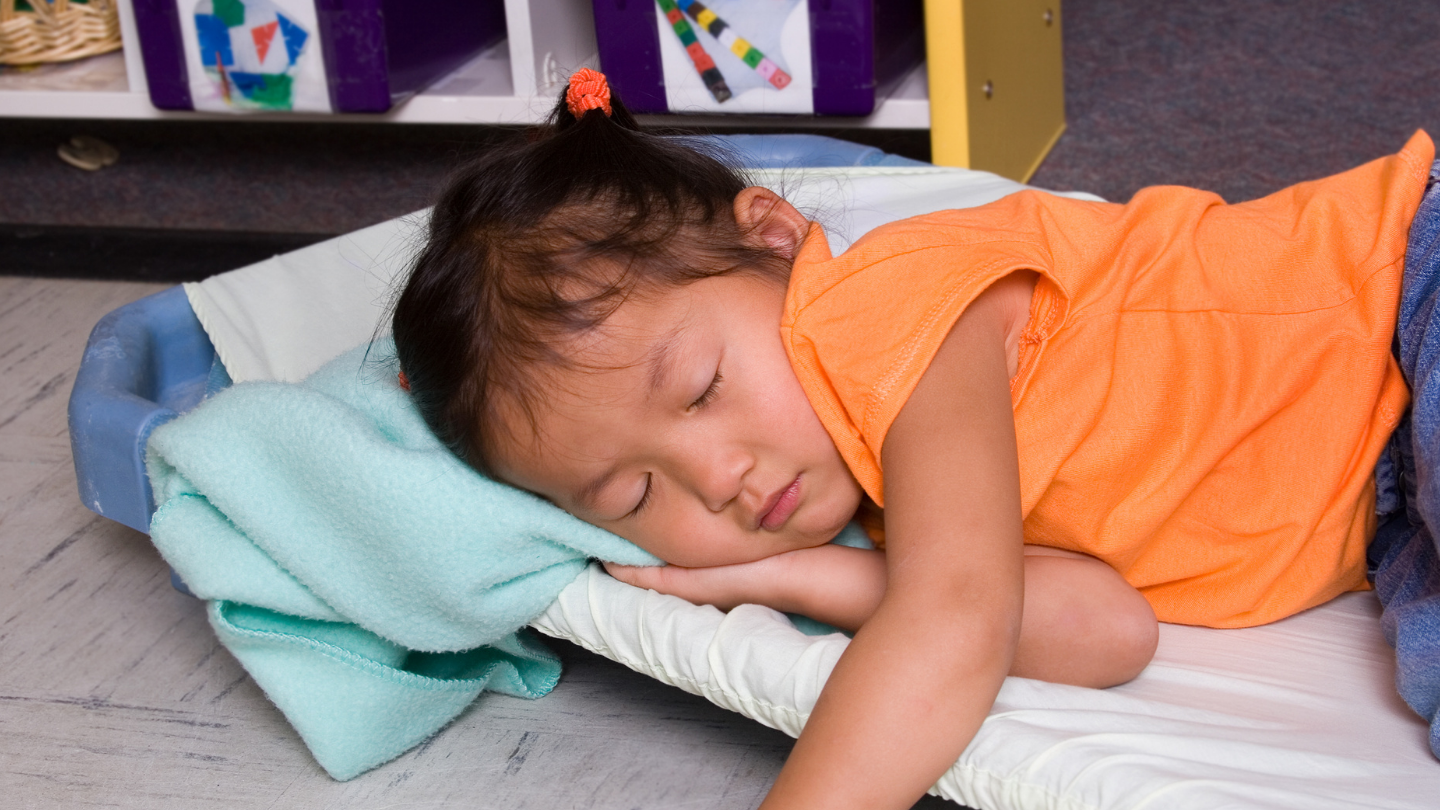
For Singapore families, the nap is what lets a later bedtime still add up to enough sleep, so it’s worth protecting. It’s also worth timing well.
A Japanese research group led by Machiko Nakagawa tracked 50 toddlers aged around 18 months with activity monitors for a week, and published the results in Scientific Reports in 2016. Longer naps, and naps that finished later in the afternoon, both pushed bedtime later and shortened the night. Their advice was refreshingly simple: naps that start early in the afternoon and don’t run too long tend to mean a longer night’s sleep.
If your child is in childcare, the nap schedule is largely set for you. On weekends and holidays, the practical rule is to keep the nap, but keep it early.
Making active play work for sleep
Put all of that together and a rhythm starts to appear.
Get outside before the nap. Morning or late-morning outdoor play gives your child daylight, which helps set their body clock, and enough exertion to make the nap come easily. A weekend Minisport class followed by lunch and a nap works with a young child’s biology rather than against it.
Late afternoon play is fine. Just leave a buffer. There’s no good evidence that active play in the late afternoon harms young children’s sleep, and for most of us it’s the coolest time to be outside. Allow an hour or so of calmer play before bed rather than going straight from running around to lights out.
Swap the evening screen for something quiet but physical. The evening screen was the most consistent sleep-stealer across every study we read. If the hour before bed currently involves a tablet, replacing it with bath, books and a bit of floor play will likely do more for sleep than any amount of daytime exercise.
Keep wake-up time steady. Regular sleep and wake times are in the guidelines for a reason. A consistent morning anchors the nap, and the nap anchors bedtime.
Why it’s worth the effort
Good sleep in these early years does more than buy you a calmer tomorrow. Singapore’s own GUSTO study, which has followed more than a thousand local children since birth, found that children whose sleep in the first few years was short and irregular scored lower on numeracy at age four than children with long, consistent sleep. The finding, published in Frontiers in Psychology in 2023 by Elaine Tham and colleagues at A*STAR, was specific and modest, but it’s a reminder that the rhythm you build now is quietly doing its job in the background.
The good news is that none of this is complicated. Move more, ideally outside. Protect the nap and keep it early. Get the screen out of the evening. Your child doesn’t need to be exhausted to sleep well. They just need a day with a shape to it.
References
- Mindell JA, Sadeh A, Kwon R, Goh DYT. Cross-cultural differences in the sleep of preschool children. Sleep Medicine. 2013;14(12):1283-1289.
- KK Women’s and Children’s Hospital. Singapore Integrated 24-Hour Activity Guidelines for children under seven years launched. 21 January 2022.
- Quah PL, Loo BKG, Chia MYH, et al. Adherence to 24-hour integrated activity guidelines among infants, toddlers and preschool children in Singapore. PLOS ONE. 2024;19(2):e0298968.
- Janssen X, Martin A, Hughes AR, Hill CM, et al. Associations of screen time, sedentary time and physical activity with sleep in under 5s: a systematic review and meta-analysis. Sleep Medicine Reviews. 2020;49:101226.
- Xu H, Wen LM, Hardy LL, Rissel C. Associations of outdoor play and screen time with nocturnal sleep duration and pattern among young children. Acta Paediatrica. 2016;105(3):297-303.
- Miller L, Dockrill M, Corkum PV, Kirk SFL, et al. Associations of objectively measured physical activity and sleep in preschoolers aged 3 to 6 years. Frontiers in Sleep. 2024;3:1329774.
- Nakagawa M, Ohta H, Nagaoki Y, et al. Daytime nap controls toddlers’ nighttime sleep. Scientific Reports. 2016;6:27246.
- Tham EKH, Xu HY, Fu X, et al. Associations between sleep trajectories up to 54 months and cognitive school readiness in 4 year old preschool children. Frontiers in Psychology. 2023;14:1136448.
Latest posts

Too young? Too dangerous? Won't listen anyway? We look at what the research actually says about sports classes for children aged 1.5 to 6 — and where the popular myths come from.
Gendered beliefs about sport form in the preschool years, long before your daughter ever joins a team. Here's what the research says, and what parents in Singapore can do about it.
© 2024 Minisport SG Pte. Ltd.